How Humidity in Southeast Asia Affects Wood Furniture—and What Singapore Homeowners Can Do
Singapore’s equatorial climate can change the moisture inside a timber table, wardrobe or bed frame more than many buyers expect. Outdoor relative humidity often ranges from 65% to 90%, while air-conditioned interiors may remain around 50% to 65%. Across a day, a timber surface can therefore absorb moisture at night and release it during the afternoon. That repeated movement affects joints, veneer adhesion, finishes and the ease—or difficulty—of assembly.
For residents of HDB flats and condos in Tampines, Bedok and Punggol, furniture must also pass through practical building constraints: lift doors are commonly about 90 cm wide, apartment corridors can be narrow, and a boxed solid wood sofa may weigh 70 to 140 kg. The right humidity strategy helps protect appearance and keeps assembly difficulty predictable, especially when a customer must move a dining table upstairs and secure its screws correctly in a compact bedroom.
MIDHILL designs solid wood furniture for export to more than 15 countries, with a 10-year structural warranty and lifetime refinishing support. Those details matter in Singapore, where imported furniture may spend time in a warehouse, cross several climate zones and be installed only weeks before it is used.
Why does humidity make solid wood furniture move?
Wood is hygroscopic: it takes in water vapour when the surrounding air is humid and loses it when the air is dry. A 180 cm dining table with a 2 cm thick top may gain enough moisture to change dimension across its grain by roughly 1 to 3 mm over a seasonal cycle. That sounds minor, but it can expose gaps around a joint, tighten one screw while loosening another, or make a drawer feel swollen.
Movement occurs most across the grain rather than along the length of the board. Solid wood bed frames may expand laterally, while a solid wood sofa can shift around its frame if the timber and upholstery are kept in very different environments. A wardrobe door may no longer sit perfectly flush with its carcass. A marble table presents a different risk: marble changes very little, so a timber base beside it can move while the stone remains stable.
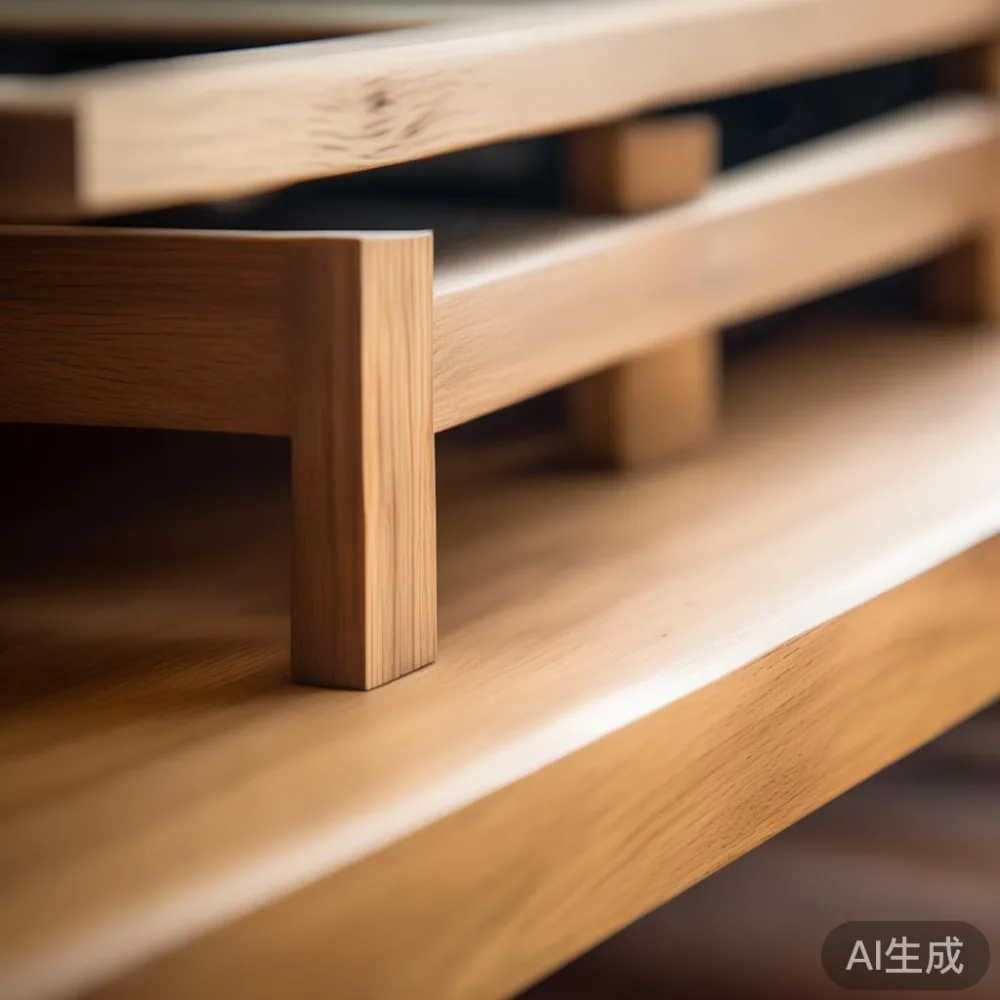
The finish also matters. A factory-applied matte or satin coating slows moisture exchange, while untreated end grain and exposed edges absorb moisture faster. Lacquered surfaces are easier to wipe clean, but scratches or chipped coatings can expose the timber underneath. A low sheen finish suits French light luxury, post-modern light luxury and American light luxury interiors because it creates a softer look than a high-gloss coating.
Singapore’s rain is only part of the issue. Air-conditioning reduces humidity indoors, but the transition from a 32°C, 80% RH corridor to a 24°C, 55% RH bedroom can still be significant. Coastal wind, enclosed HDB corridors and ground-floor units may experience wider fluctuations than a high-floor condo. Proper acclimatisation should therefore happen gradually rather than with sudden heat or moisture exposure.
How much assembly difficulty does humid weather create?
Assembly difficulty rises when timber arrives with a moisture level that differs from the room in which it will be installed. The main issue is not that wet wood is automatically weaker. Dense hardwoods remain structurally sound at normal indoor moisture levels. The difficulty appears when the frame changes after bolts, dowels or cam locks have already been tightened.
For example, a 200 cm wardrobe with eight doors may require 60 to 100 fasteners, depending on the construction. If its panels expand by 1 mm after assembly, one hinged door may catch the carcass. A dining table with four legs may rock if one leg absorbs less moisture than another. A nightstand drawer may swell enough to require a small adjustment after 14 to 30 days.
Keep furniture in its packaging for 48 to 72 hours if possible, especially when the timber has travelled from a cooler or drier region. Stand the carton upright and leave the wrapping unopened until the wood has adjusted to the room. Remove plastic only after the outer surfaces feel close to room temperature. If the packaging cannot remain closed, leave the panels loosely covered and allow another 24 hours of circulation.
Do not force a swollen drawer or tighten every screw as tightly as possible on day one. Follow the specified torque, leave seasonal movement allowances where provided, and recheck connections after 7 days and again after 30 days. These habits reduce assembly difficulty without sacrificing stability.
What should I do before accepting a furniture delivery in Singapore?
Measure the route before ordering, not after the item reaches the lift lobby. A standard HDB or condo access route may include a 90 cm wide lift door, an 80 to 100 cm corridor and a staircase with a 120 cm turning area. At the doorway, leave clearance of at least 5 cm around the largest dimension of a boxed item. For a solid wood bed frame, compare the frame width—commonly 150 to 200 cm—with the bedroom door and lift dimensions.
Record the lift’s internal size and ask the building management whether oversized-item bookings require 24 to 72 hours’ notice. A marble table may arrive in separate protected sections weighing 25 to 80 kg per piece, while a solid wood sofa may arrive as 2 or 3 sections weighing 45 to 75 kg each. Confirm whether the delivery team carries items beyond the lift or lobby, because corridor turns affect assembly difficulty and may require 2 people for 15 to 20 minutes per floor.
For local purchases, prices are normally stated in SGD and include applicable GST. MIDHILL offers free shipping on orders above US$350, although the threshold may be converted or applied according to the checkout terms. Singapore deliveries commonly require 7 to 21 days for in-stock pieces, while made-to-order furniture can take 6 to 12 weeks. Check the promised delivery period before arranging access, and keep the 14-day return window in view if visible damage or finish defects are present.
Inspect the delivery note in good light. Look for swollen packaging, softened particleboard edges, water marks, chipped corners and cracked marble. Photograph the pallet and each carton before opening them. If a carton has been left beside an open window or in a wet loading area, allow 48 hours for drying and report the condition promptly rather than beginning assembly.
How can I protect a dining table, wardrobe and bed frame from humidity?
Begin with the room rather than the furniture. Use a hygrometer placed 1 to 2 m above the floor and away from vents or windows. Aim for approximately 45% to 65% RH for stable indoor conditions. A reading of 70% for 12 hours is not automatically damaging, but repeated readings above 70% make close inspection and careful moisture control sensible.
For a dining table, place felt pads beneath every leg and use a stable rug rather than one with a rubber backing that traps moisture. Keep the table 20 to 30 cm away from curtains, exterior walls and air-conditioning outlets. Wipe spills within 10 minutes. Avoid steam cleaners, wet cloths and silicone-based furniture polish, which can leave residue or drive moisture into joints.
For a wardrobe, leave 3 to 5 cm behind the carcass if space permits, and use adjustable levelling feet where available. Do not wedge the back panel tightly against the wall if seasonal movement is expected. Open the doors briefly every day so trapped humid air can escape. Inside, store folded clothing rather than damp towels, and keep any box of spare timber away from the floor.
For a bed frame, ventilate the room for 20 to 30 minutes after air-conditioning stops, then run the system in moderate mode during humid periods. Keep bedding 5 to 10 cm from the headboard if condensation is visible. Check the leg fixings after the first week, but avoid repeated tightening. If your design plan includes how to style light luxury bed in apartment, use breathable cotton or linen textiles and preserve airflow around the solid wood frame.
What is the best way to care for a marble table in a humid climate?
Marble does not absorb atmospheric moisture like timber, but its joints, base and packaging still require attention. Keep a marble table away from direct rain, open windows and leaking air-conditioner condensate. Use a pH-neutral stone cleaner with a soft cloth, and dry the surface within 5 minutes. Avoid vinegar, lemon juice, acidic bathroom cleaners and abrasive pads, which may etch the stone.
Allow the table to acclimatise for 24 to 48 hours before attaching any top section to a timber base. Inspect the underside after 7 days. If the stone is fixed with adhesive, the manufacturer should specify whether installation can occur at a particular moisture range. Do not attempt to correct alignment by driving additional screws into the marble or base.
Use a level mat beneath the base and maintain 30 to 50 cm of clearance from exterior walls where possible. A coaster under a humid glass or vase prevents mineral-rich condensation from forming a ring. Compared with a timber dining table, a marble table changes dimension very little, but the surrounding floor and timber components can still move.
Can humidity affect the finish and appearance of solid wood furniture?
Yes. Repeated moisture uptake can dull a finish, raise faint surface grain or contribute to joint-line movement. These changes are not always defects, but abrupt exposure can make a finish look uneven. Keep furniture out of direct sunlight for more than 2 to 3 hours per day, especially where UV exposure can also fade the colour.
Use a dry microfibre cloth for routine cleaning and a lightly damp cloth only when needed, followed by immediate drying. Renew the protective finish according to its instructions, often every 12 to 24 months in a humid home. Test an inconspicuous area first. The lifetime refinishing support available from MIDHILL can help restore the original surface after years of use rather than replacing a structurally sound piece.
Colour differences are natural between boards and should not be interpreted as moisture damage by themselves. However, dark marks near joints, persistent musty smells or peeling film require investigation. Keep a moisture meter nearby and record readings; a wood moisture meter commonly targets 8% to 12% for many indoor applications, but the ideal figure depends on the species and local service climate.
Will a solid wood sofa behave differently in a humid HDB flat?
A solid wood sofa combines timber structure with cushions and textile layers, so it can respond to humidity in more than one way. The frame may move slightly, while foam can compress differently in humid conditions and upholstery may wrinkle as it absorbs moisture. High-floor units in Punggol may experience stable interior temperatures, whereas a ground-floor Bedok flat near a wet courtyard may need closer monitoring.
Allow at least 24 hours before tightening the back or seat connections after delivery. Keep the sofa 15 to 30 cm from the wall where practical, and avoid placing it directly beside a frequently opened window. Remove loose covers for laundering according to the care label, and use a dehumidifier if readings remain above 65% for several days.
Style should follow the room rather than distort it to hide climate effects. Pale timber, slim legs and restrained profiles suit European for small living room layouts, including compact HDB living rooms. If comparing silhouettes, European sofa vs French provincial sofa helps distinguish clean, rectilinear forms from carved details and softer curves. In a humid apartment, simpler upholstery and smooth solid wood edges also make cleaning more manageable.
How do I choose furniture that will remain stable in Southeast Asia?
Look for solid timber construction, sound joinery and finishes suited to humid conditions. Ask whether cross-grain components have movement allowances and whether the supplier provides moisture-care instructions. A 10-year structural warranty indicates confidence in the frame and joints, while a 14-day return policy gives a limited period to report transport damage. Neither replaces acclimatisation, but both help distinguish manufacturing concerns from normal seasonal movement.
For a larger wardrobe, plan the internal layout around the actual room dimensions and the route from the lift. If the wardrobe is 180 cm wide and 220 cm tall, a tight corridor turn may require the carcass to be assembled inside the bedroom. This makes assembly difficulty more significant than for a flat-pack nightstand. Ask for the carton dimensions, module weights and an installation sequence before delivery.
The same planning applies when researching how to style American wardrobe in apartment: a built-in-looking configuration should still permit airflow behind the frame. For bedrooms, comparing light luxury bed vs Japandi bed can clarify whether the preferred design uses a padded upholstered headboard or a clean timber frame, both of which require slightly different humidity routines. If you are deciding between options, how to choose European light luxury bed should include a room measurement and moisture check.
When is humidity movement a defect that needs professional attention?
Report a problem when a joint has separated, a crack extends through the board, a screw head has pulled away from the timber, a marble top has fractured, or a door frame has warped enough to prevent closure. Record the room humidity, when the furniture arrived and when the issue appeared. Include photographs and a 10-second video of the affected joint.
Do not add glue, foam or filler to conceal swelling before the furniture has adjusted for 14 to 30 days. Excess tightening can strip the hole and make later repair harder. For a structural concern, stop using the affected component. A heavily loaded dining table with a moving leg may need support; a wardrobe joint that pulls away should not carry hanging clothes.
Singapore’s climate calls for controlled acclimatisation, sensible placement and regular checks. Humidity will not prevent a well-made solid wood bed frame, wardrobe, nightstand or dining table from serving an apartment for many years, but it can turn a small movement into visible stress if assembly and care are careless. Keep the indoor environment near 45% to 65% RH, allow 48 to 72 hours for acclimatisation, inspect connections after 7 and 30 days, and address structural movement through measured advice rather than force.